
4 Tips To Ease Sciatic Nerve Pain

Sciatica can be a real pain the butt! Literally! The pain associated with sciatica can limit you from doing things like bending over to put on your shoes, shaving your legs, or sitting at your desk job for a full eight-hour shift. Some people will even report a significant increase in sciatic nerve pain with coughing or sneezing. For most people, sciatica comes and goes within a couple weeks. Unfortunately, for some it tends to linger far beyond the expected time frame of healing causing significant limitations and disability.
Sciatica refers to pain that radiates along the path of the sciatic nerve which extends from the lower back, through your hips and buttocks, and down the back of the thigh, lower leg, and calf (and sometimes into the foot). Sciatic nerve pain can occur in conjunction with or without lower back pain depending on the severity. The pain can vary widely from a dull muscle ache to sharp excruciating burning sensation. Typically, most cases of sciatica only affect one side of the body but it is indeed possible for it to affect both sides. When sciatica goes untreated for a long period of time it is also possible to develop significant leg weakness on the side of the pain.
There are many potential causes of sciatic nerve irritation and pain. One common cause is entrapment of the sciatic nerve underneath the piriformis muscle of the hip. The piriformis muscles are located deep within each buttock. The sciatic nerve runs from the lower spine (lumbar spine) underneath the piriformis (into the buttock) and down the back of the leg. When the piriformis muscle goes into spasm, it can become tight and entrap the sciatic nerve. In contrast, if the sciatic nerve gets irritated it can become inflamed and be further irritated from running underneath the piriformis muscle.
Another common cause of sciatica is due to a herniated disc in the lumbar spine. In healthy human beings, we have little gel-like discs between each of our spinal (vertebral) bones. These discs provide shock absorption properties to help support the spine. It’s important to note that our spines are built very sturdy and able to withstand high amounts of forces. If outside forces are applied to the spine with enough force and at just the right angle, you can herniate your disc from its normal position. The most common type of disc herniation occurs posteriorly (meaning it herniates backwards). Unfortunately, the nerves that supply sensation (feeling) and your ability to move your muscles in your legs and feet come out from the spinal cord directly behind the discs. When the disc bulges backwards, it puts pressure and irritation on the nerves which then causes discomfort and pain down the buttock extending down into the thigh and calf (and even feet in some cases). Most of these types of disc bulges occur when we are lifting something too heavy with poor body mechanics or due to trauma to the spine directly. I also want to point out that not all disc bulges are always abnormal and pain generators. In situations where an x-ray or MRI report shows a disc bulge in the lower back without any significant traumatic event or injury, it’s probably nothing to worry about and not the thing generating your pain.
So, whether you’re just experiencing a mild flare up or your going on a few months of sciatica, there are some things you can do to help ease the pain and facilitate a faster recovery.
1. Stretch out your piriformis
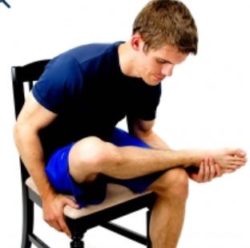
The piriformis muscles can be stretched in a variety of positions. Today, we will discuss how to stretch the piriformis in a seated position. I really like stretching in this position because we are able to stretch both the piriformis and with a slight modification we can stretch out the entire hip. To stretch the piriformis while sitting in a chair, first cross your leg with the ankle of one foot on the knee of the other. Next, pull the top knee upward towards your opposite shoulder for a stretch (Figure A). To get a stretch deeper into the hip, cross your affected leg on top of the other as shown below. Next, gently lean forward until a stretch is felt along the crossed leg (Figure B).
Perform these stretches on both legs regardless if your other leg has pain or not. If your painful leg is too painful and you’re unable to stretch, try stretching the other leg. There are many people I have treated in the past that have said that stretching the non-painful leg provided significant relief to the painful leg. If you can tolerate it, be sure to stretch both sides. Hold these stretches for 30 seconds and perform them 3-5 times per day.
Figure A

Figure B
2. Floss those sciatic nerves
The next exercise is called sciatic nerve flossing or sciatic nerve gliding. This exercise helps to improve the mobility of the sciatic nerve and reduce inflammation along the nerve from the buttock down the bottom of the foot. Start in a slouched position. Next, extend from your waist up while you straighten your knee and pull your toes up towards your nose. NOTE: Stop whenever in that leg/ankle motion you begin to feel a stretch/tingling/warmth and back off towards the starting position. Again, if your painful leg is too painful and you’re unable to stretch, try stretching the other leg. If you can tolerate it then perform on both sides. There are many people I have treated in the past that have said that stretching the non-painful leg provided significant relief to the painful leg. Perform this exercise for 2-3 sets of 10 repetitions about 3 times per day (Figure C).
Figure C

3. Try some press ups
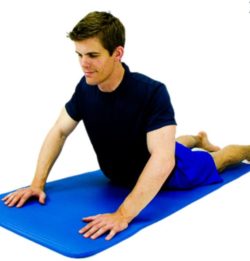
The press up exercise is a great way to relieve sciatic nerve pain associated with a herniated disc. This exercise helps to relieve pressure on the nerves coming out of the spine from the herniated disc. If you notice that your sciatic nerve pain is increased when bending forward, this exercise may help you significantly. Start by lying face down then slowly press up and arch your back using your arms. Perform this exercise for 3 sets of 10 repetitions about 3-5 times per day (Figure D).
Figure D
4. Perform some self-trigger point release
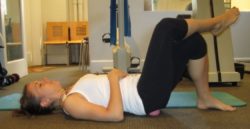
Although very uncomfortable, self-trigger point release to the piriformis and glut (buttock) muscles can help to provide significant relief from sciatic nerve pain. Using a tennis ball, golf ball, or lacrosse ball (whatever you can tolerate best), first try lying flat with the ball directly underneath the painful region in the buttock. If you can tolerate putting your legs up onto a chair to help flatten your back, give it a shot as this will put more pressure on that painful region. You can also try the self-trigger point release in a seated position. Apply direct pressure to the painful area with the ball for 1-2 minutes or until you feel a release of pain in the buttock region. Follow this up with 10-15 minutes of ice application with a towel medium between the skin and the ice pack to help reduce soreness (Figure E).
Figure E
ABOUT THE AUTHOR:

Dr. Garrett Desrosiers PT, DPT
Garrett is the CEO and Co-Owner of ProResults Physical Therapy Inc. in San Marcos, CA (North San Diego County). Garrett has been helping on-the-go active adults and athletes across the south western United States return to a pain-free active lifestyle without medications, injections, surgery or making unnecessary trips to the physician’s office since 2015. He graduated in 2013 with his Bachelors of Science in Kinesiology then went on to receive his Doctorate of Physical Therapy from Husson University in 2015. After working for three years in multiple fast paced outpatient orthopedic physical therapy clinics, Garrett quickly realized he was not able to provide the elite quality care he knew his clients deserved. Garrett felt clients were more than just a number or diagnosis and that in order to provide the time, empathy, passion, and high-quality treatment they deserved, starting his own private practice was the only option. Garrett is committed to helping every client make the best decision in regard to their health. His unique, personalized, eclectic, multifaceted approach takes those individuals who have decreased their activities or stopped being active all together to a real solution.
Photos taken from www.hep2go.com